

April 21, 2025
Tokyo had been quite good to us in the past 6 days, but Carlos and I were ready to move onto our next destination in Japan: Kyoto.
To get there, we would be taking the bullet train (shinkansen) for the first time on our trip, and we were excited for it!
However, we were in no rush. We slept in this morning before getting up around 8 a.m. to finish packing and get ready.
While waiting for rush hour to end, I decided to go to a local supermarket, Aeon Food Style Funabori, which was a very short walk from the hotel. I wanted to get some snacks and see if they had some things for a couple friends, and I thought it would be an interesting experience. I took my time and wandered around, checking out all the different aisles and products, and it was a pretty chill atmosphere in there. I ended up getting some snacks for our breakfast.
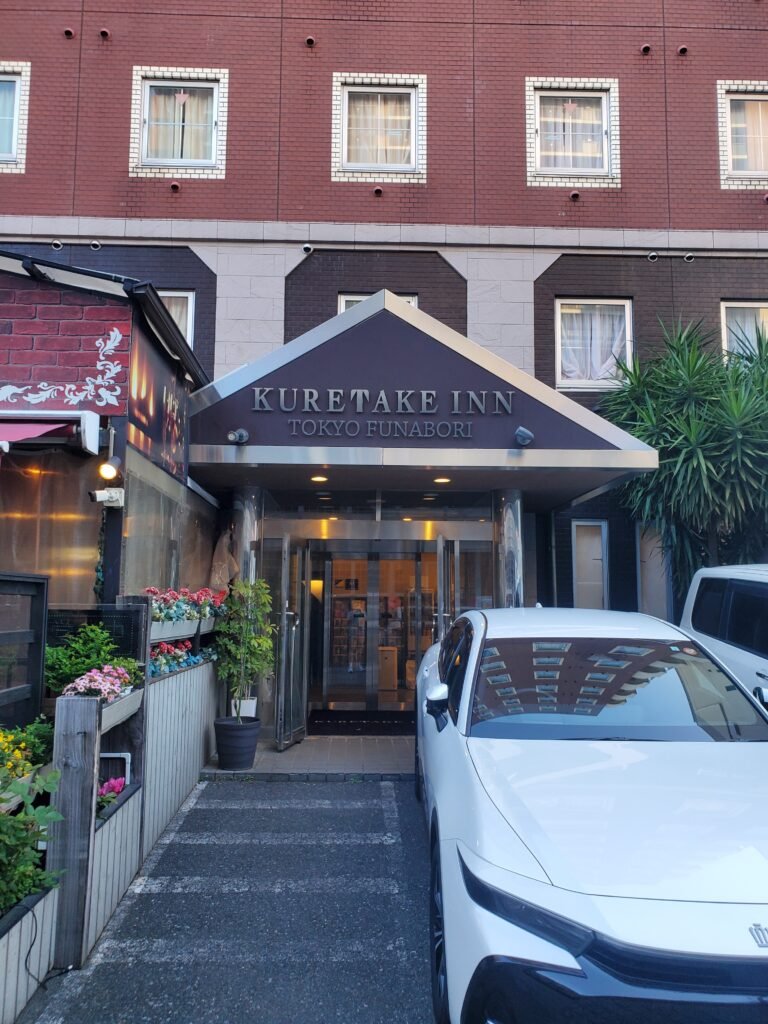
Around 9:30, just after the morning rush, we headed out – planning to arrive in Kyoto between 1 and 2. We briefly thought about stopping at some local shrines near Funabori Station, but none of them offered goshuin stamps. One of them, Hoei Inari Shrine, surprisingly did have an annual April 21 ritual, but it seemed low-key enough that we didn’t worry about missing it.
We did not get shinkansen tickets in advance, but bought tickets at Shinagawa Station. That being said, I would recommend pre-booking the bullet train between Tokyo and Kyoto, especially if you want a view of Mount Fuji. We ended up reserving seats on the left-hand side for a train which was set to leave about 40 minutes later (the view is on the right on the way to Kyoto). You can buy non-reserved seats as well, but I wouldn’t recommend it.
When purchasing tickets, keep in mind you need both the basic fare (covering distance) and the express surcharge (for speed/reservations). We had to go back and buy the basic fares, though there was a lady at a desk who helped us out with it. I also stressed a bit about one bag looking too large in a baggage sizer there, but it ended up fitting just fine.
It cost a little over ¥13,000 apiece for the bullet train, or just under $100 USD at the time.
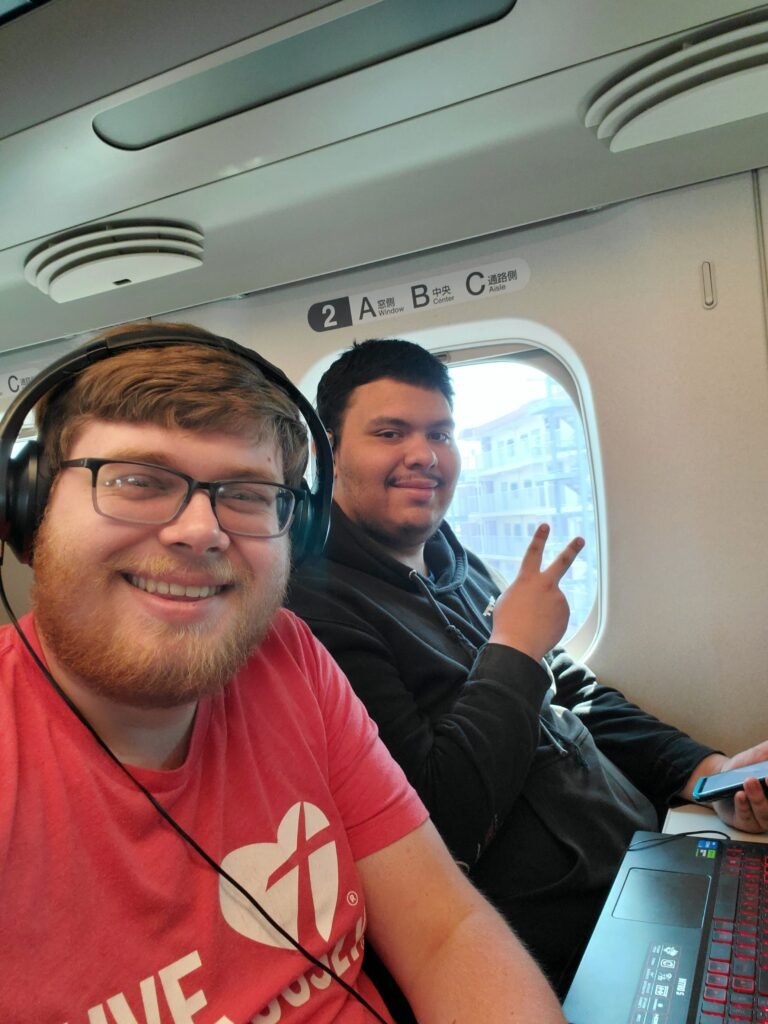
After smoothly passing through the security gates (where you insert both your fare and ticket at the same time), we made our way to the platform. We hung around for a bit, and honestly, it was kind of mesmerizing to watch the trains glide in and out.
When our shinkansen arrived exactly on schedule, we boarded quickly. We stowed our bags in a special luggage area near the front of the car, secured by a handy little clip-down barrier. Then we settled into our seats, and Carlos pulled out his laptop so we could watch a movie (Sonic 3 if you’re curious). The journey down to Kyoto would be just over 2 hours.
While a plane ride would be shorter and cheaper, this is a much cooler way to see the country, and time-wise I don’t think flying is worth it. Either way, the bullet train is a must-have experience when visiting Japan.
We pulled out of the station right around 11:10 a.m., and we were immediately struck by how quickly the train accelerated – it was almost like taking off on a plane! Bullet trains in Japan can reach speeds around 186 mph, and it was awesome how fast we picked up speed. Later on I took a video, and it looks as if I sped it up – but that’s the real deal!
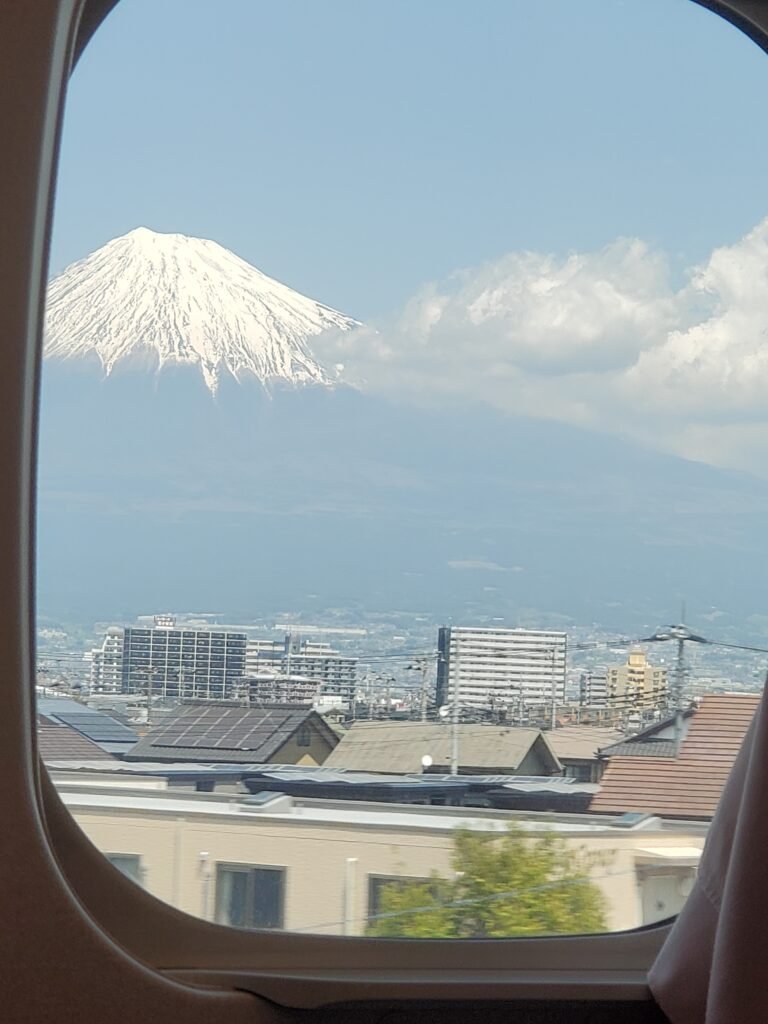
I was a bit worried that we wouldn’t get to see Mount Fuji due to our seating arrangements, but my fears abated about thirty minutes into the ride. There it was – a beautiful sight, stretching above the horizon and capped with snow. The sheer scale was just unreal – we could see it looming for quite a while. The shinkansen’s large windows made it easy to snap some photos, even sitting on the other side of the train!
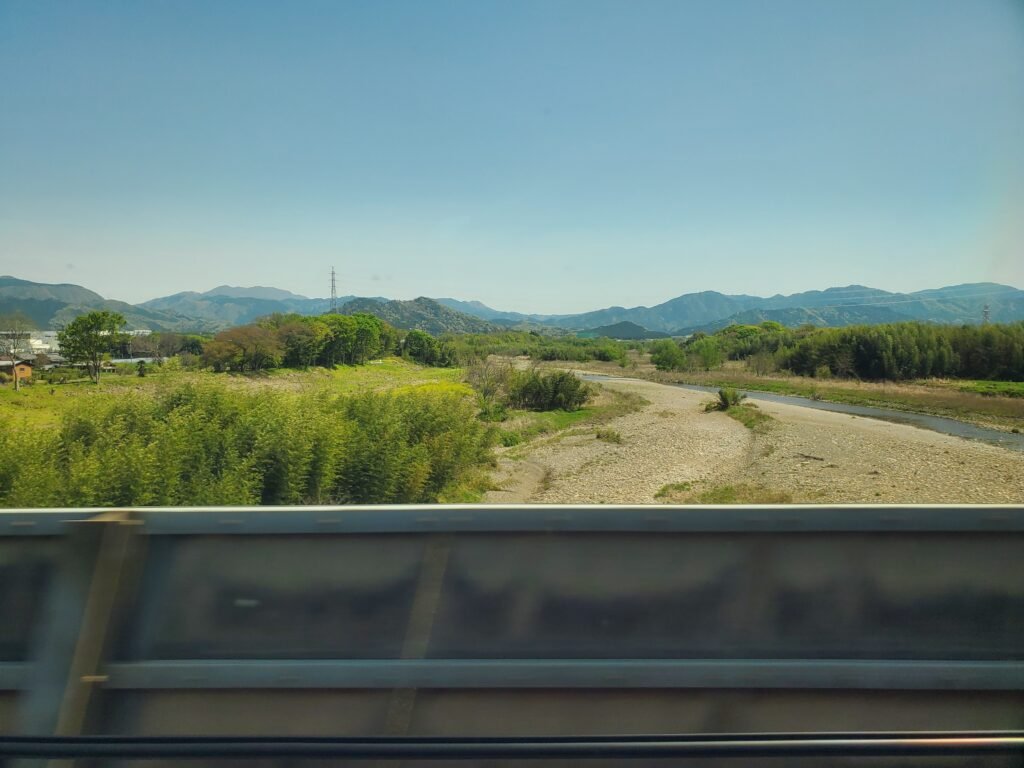
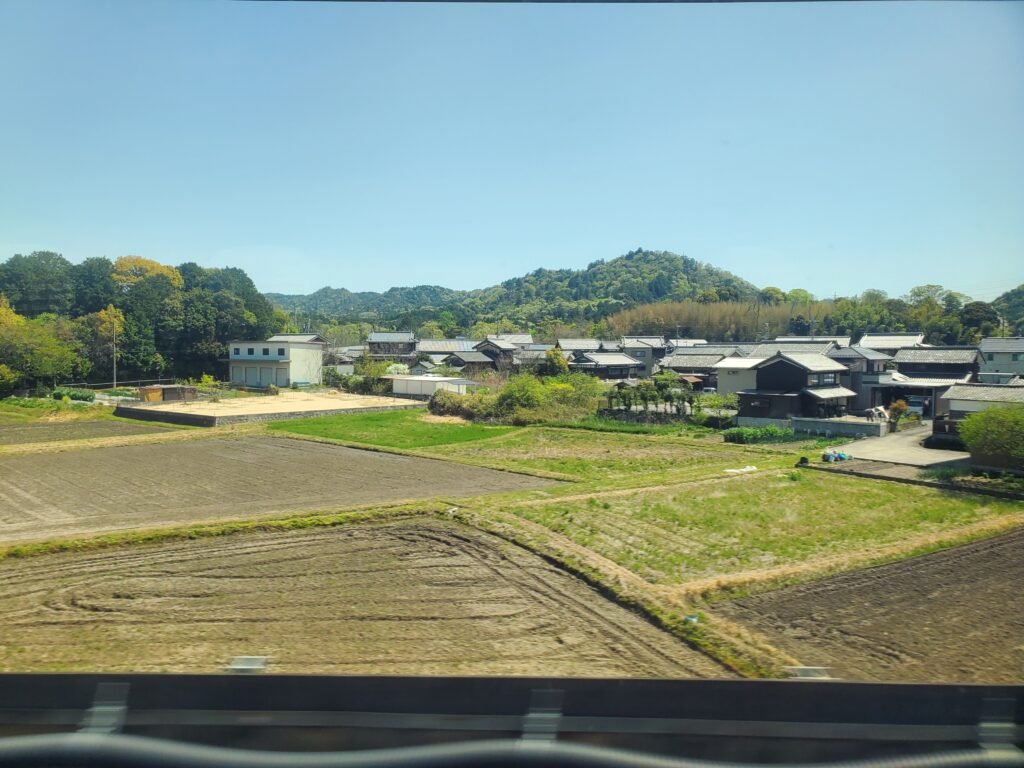
The rest of the ride was full of sights – urban sprawls with dense cityscapes we briefly passed through, lush rolling hills bursting with greenery, winding rivers, endless rice paddies, and quaint little towns dotted with traditional Japanese houses. Fun fact: we even passed through the sister city of my hometown!
Once we arrived in Kyoto, the bustling Kyoto Station was a bit of a maze, but we managed to navigate it smoothly. We transferred to one of the subway lines from there.
Upon emerging from the last station, we immediately noticed how differently the streets were laid out in Kyoto. We walked for about 10 minutes along mostly the same street, and it was a bit of a struggle with our bags – both because the street and the sidewalk were so narrow, and one of the wheels on Carlos’s suitcase lost some of its rubber.
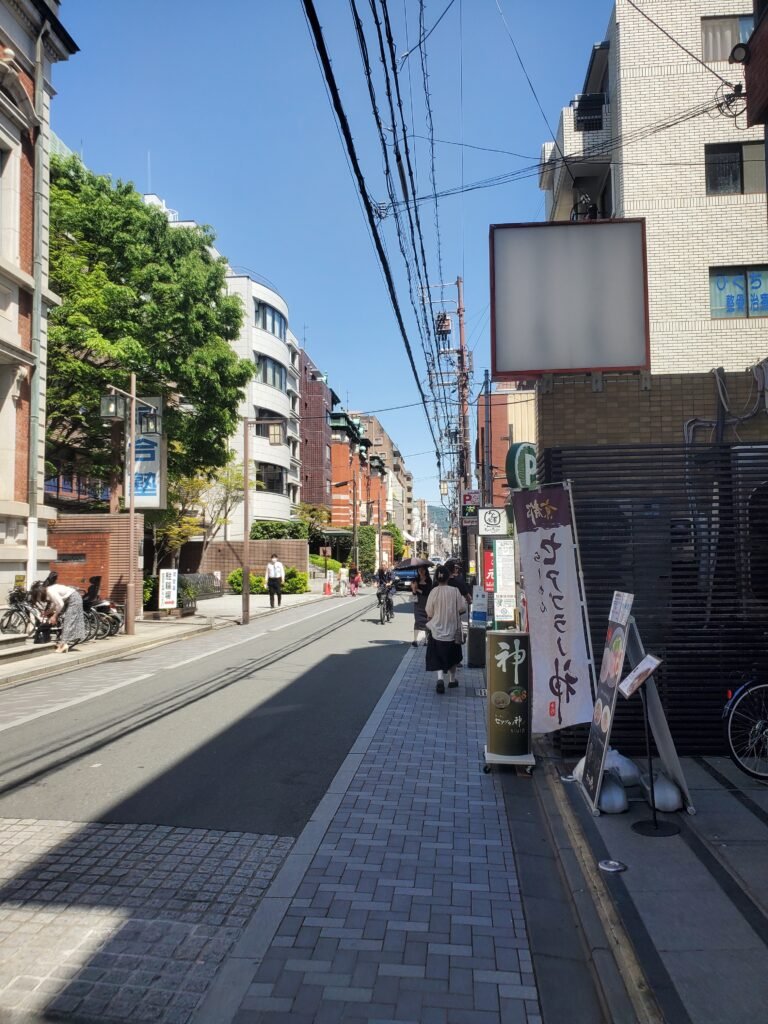
For context, Kyoto was never bombed in World War II like Tokyo and other major cities, so the streets are less car- and train-friendly – though this actually makes the city incredibly pleasant to explore on foot. Considering it was once the capital of Japan, there are tons of very old buildings, giving the streets a really lovely historical atmosphere.
We made it to our hotel, though check-in wasn’t until 3 p.m. Luckily, the gentleman at the desk kindly allowed us to leave our bags, which was perfect since we were absolutely starving. As we stepped outside, we realized that our hotel was right next to an awesome shopping area – two long streets full of shops and restaurants. A perfect place to look for lunch.
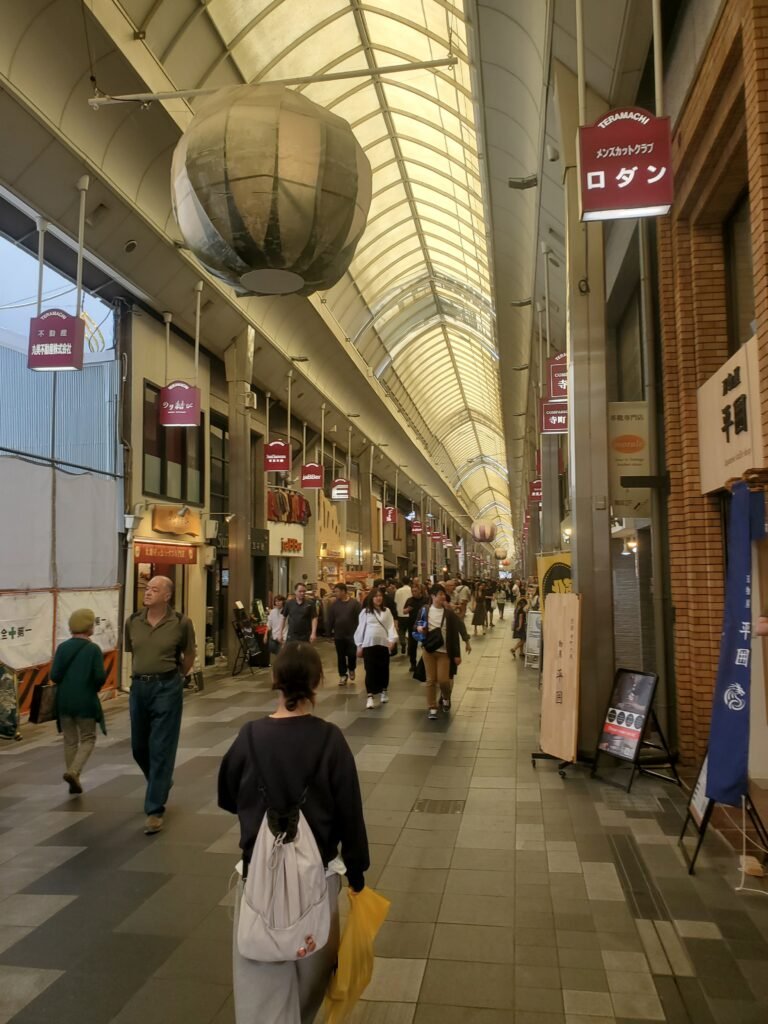
We browsed around, looking for a good restaurant, keeping a couple options in mind. One in particular caught our eye: Ichiba Coji Teramachi. It ended up being an excellent choice, easily our favorite restaurant of the entire trip – and that’s saying a lot, considering I would visit four other countries later on this journey.
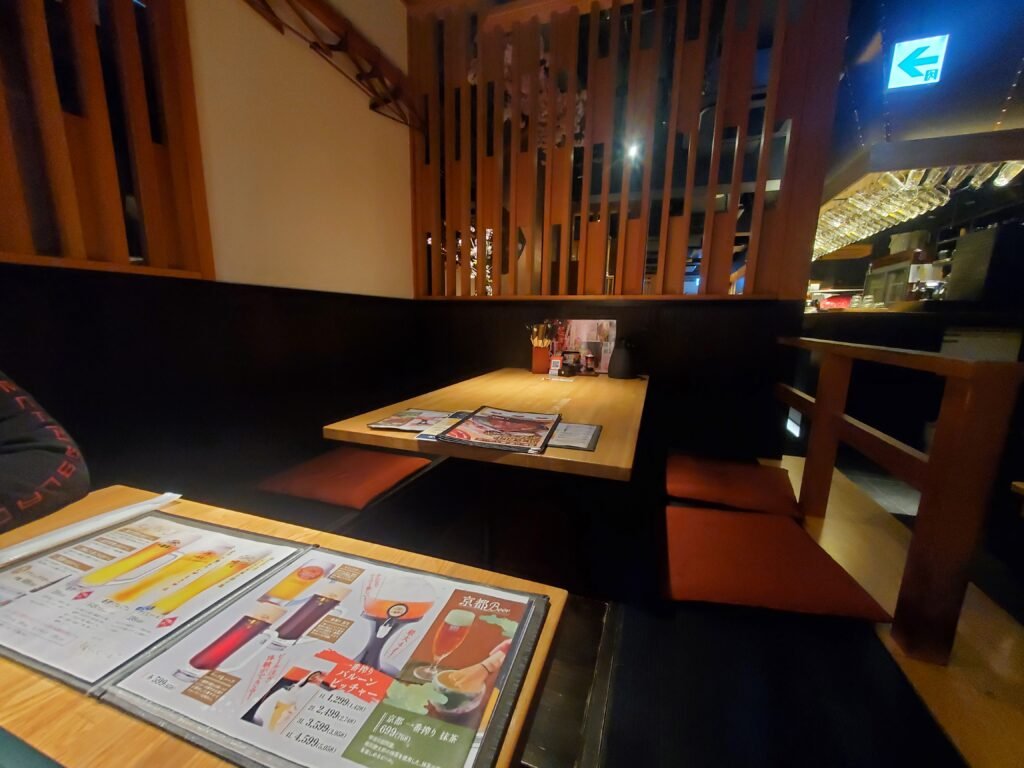
We sat at inset tables in which you had to take your shoes off first (tatami seating). The only slightly tricky part of the meal was ordering. Instead of a menu, we were given a QR code to scan, which took us to a Japanese-only website. I had my heart set on trying the wagyu, but I clearly misread something – because instead, I ended up ordering some sort of stewed beef tendon. It was the exact same price as the wagyu (¥1,859), but I wouldn’t realize my mix-up until the food arrived!
When the food came, I was a little surprised not to see wagyu on my plate, but my beef tendon was still incredibly good. We were also a little shocked at how big our meal was – the outside advertisements showed the main courses, but the set meal came with much more than just the main dish: eight varieties of obanzai (traditional Kyoto side dishes), homemade oboro tofu, multigrain rice, and miso soup.
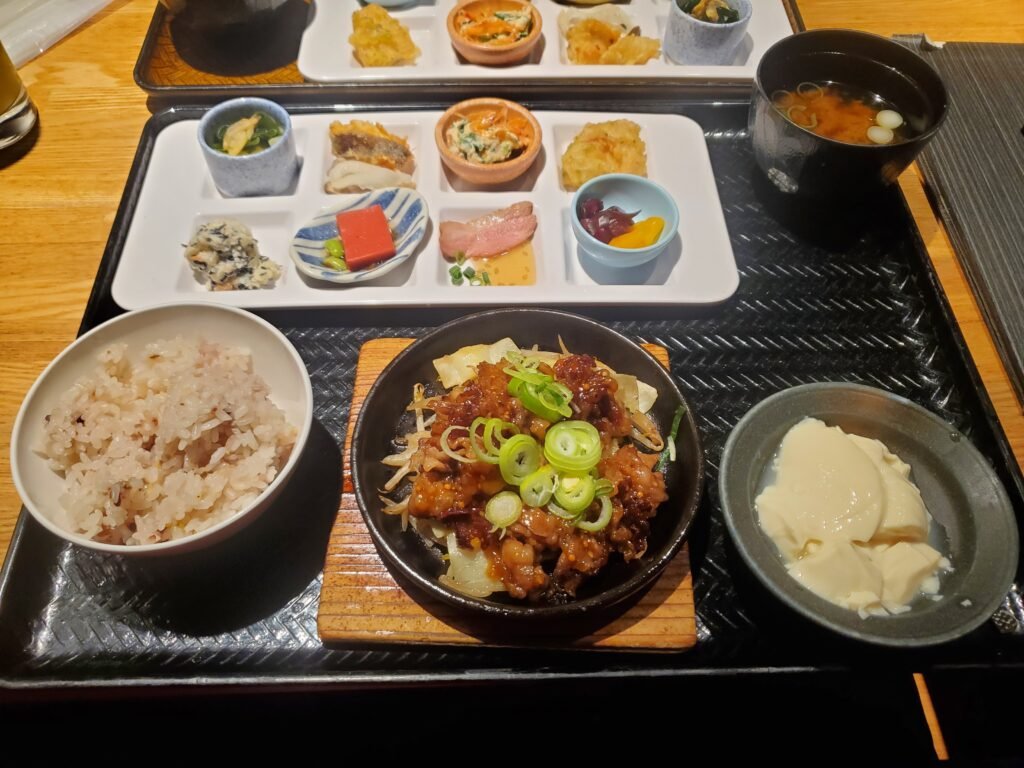
The tofu wasn’t really our thing, but the rice and soup were both good. The obanzai were hit-and-miss, but all unique – some felt like acquired tastes, while others were instantly delicious. Carlos did order some wagyu and let me try some, and it was really good.
When we did the math after finishing up and paying, we realized we had basically gotten a gourmet meal for the equivalent of around $36 USD. That’s crazy cheap for something this good – in the States we figured this probably would’ve been over $100! We left completely satisfied – so much so that we agreed on the spot to come back the next day, and have dreams of one day returning.
After lunch, we headed back to the hotel, since it was about 3 p.m. and check-in time had finally arrived. We were staying at the L.A. MART HOTEL KYOTO, and the place turned out to be a pretty great find – our room was a decent size with two twin beds so comfortable and soft that you just sank right in and didn’t want to get up. One quirky detail was that you had to return your key to the front desk every time you left, but it was quick and easy, and the staff were incredibly kind.
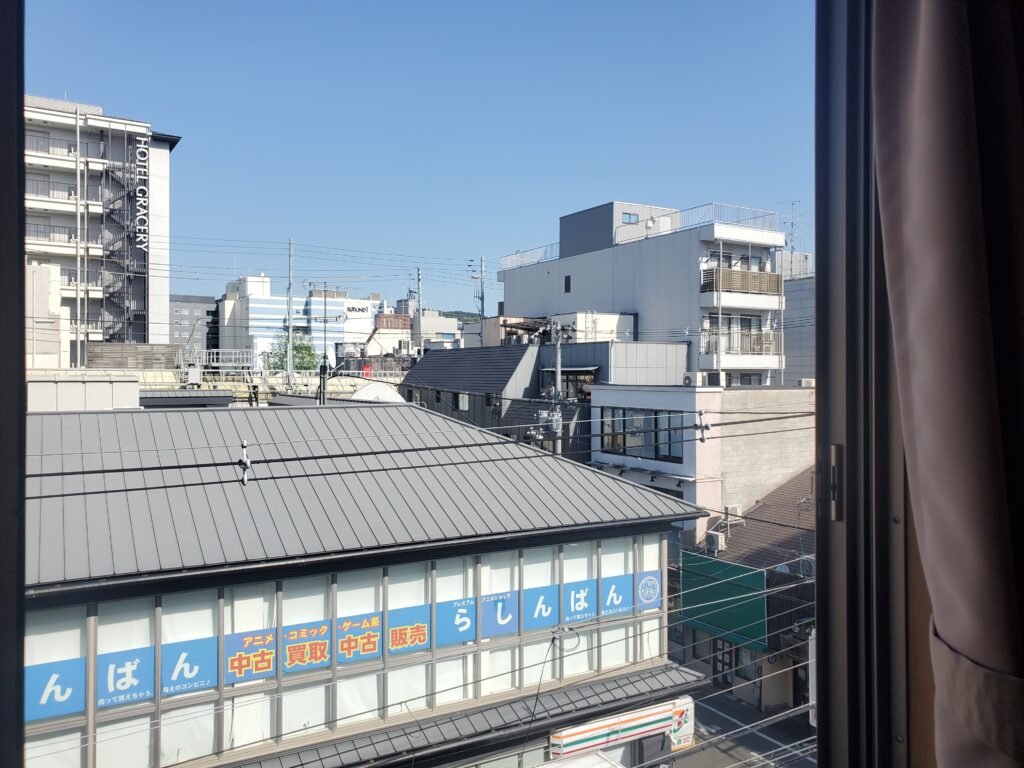
The location couldn’t have been better – there was a 7-Eleven right next door, and those two long shopping streets were just steps away. The only slight downside was that the walls were a bit thin, so we could hear some of the street sounds, but honestly, by the time we hit the beds each night we were so tired we barely noticed. We’d only be here for two nights, but it already felt like a comfortable little home base in Kyoto.
By 4 p.m., we were back outside, ready to explore again. Our goal was to visit more shrines and temples to collect goshuin stamps, and conveniently, one of them was right along the same shopping streets. This was Eifuku-ji Temple (Takoyakushi-dō) – a tiny but distinctive spot tucked right into the arcade. The octopus is a symbol of health here, and the imagery is everywhere – wooden carvings, models, even plush dolls. Another interesting note was that there was a sign that asked for worshippers not to perform the custom two claps after ringing the bell, because it is a Buddhist temple and the clapping is a Shinto tradition. Inside, a kind woman at the desk wrote our goshuin stamps, making the visit feel more personal.
After our visit there, we made our way towards the bus station. Boarding the bus was straightforward; we tapped our IC cards upon entry and exit. Even though it was a short ride, I kept pointing out McDonald’s seemingly at every corner! They are truly everywhere in Japan! After getting to our stop, we began our ascent toward Kiyomizu-dera. This temple, founded in 778 AD, is one of Kyoto’s most iconic landmarks.
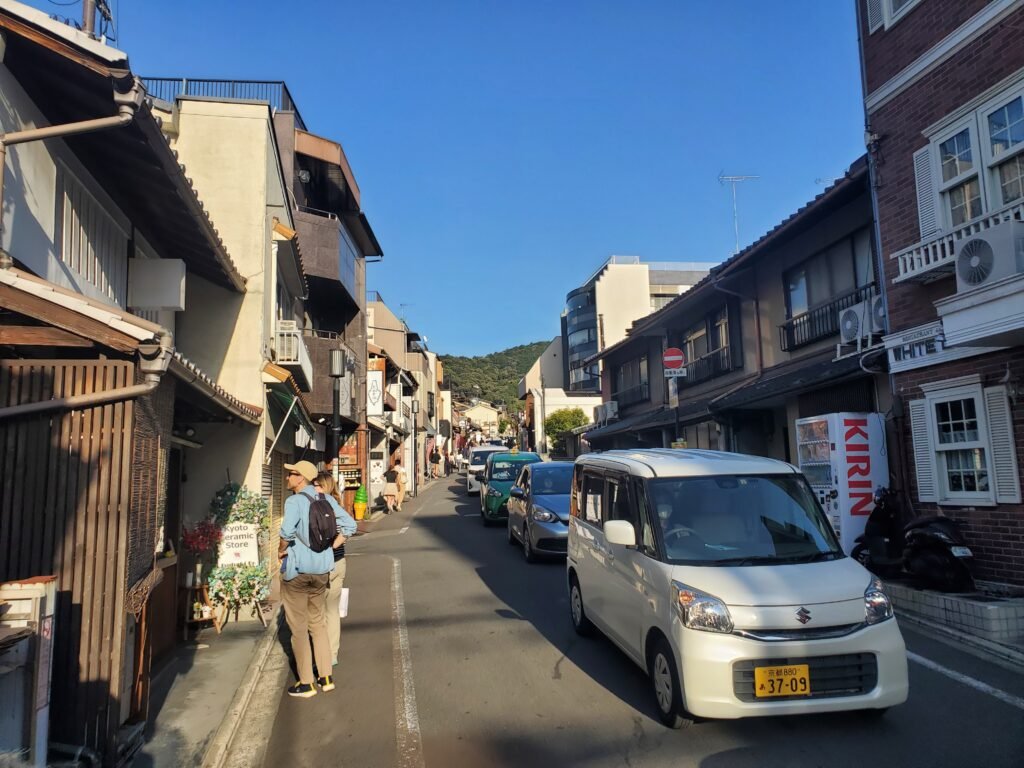
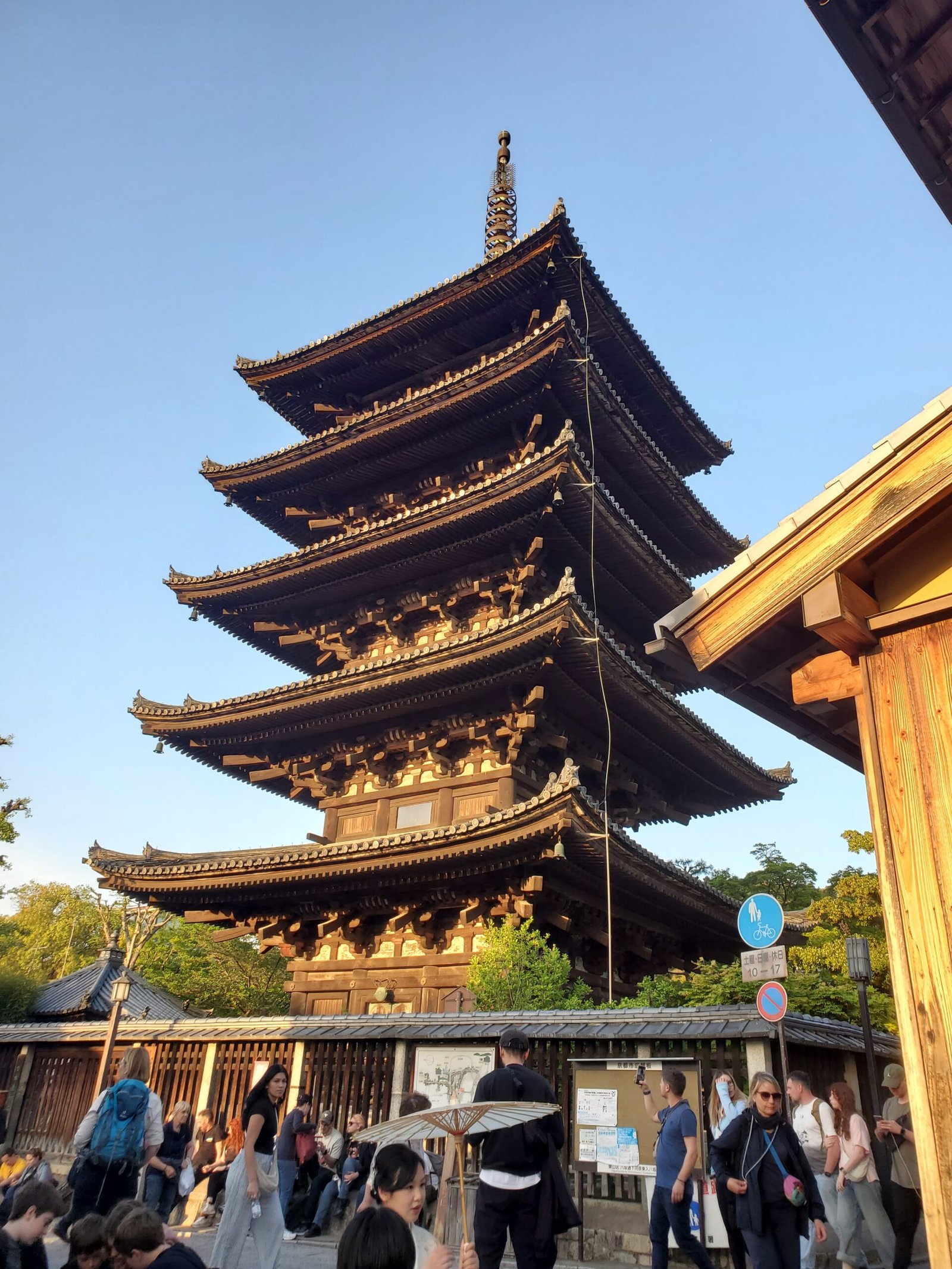
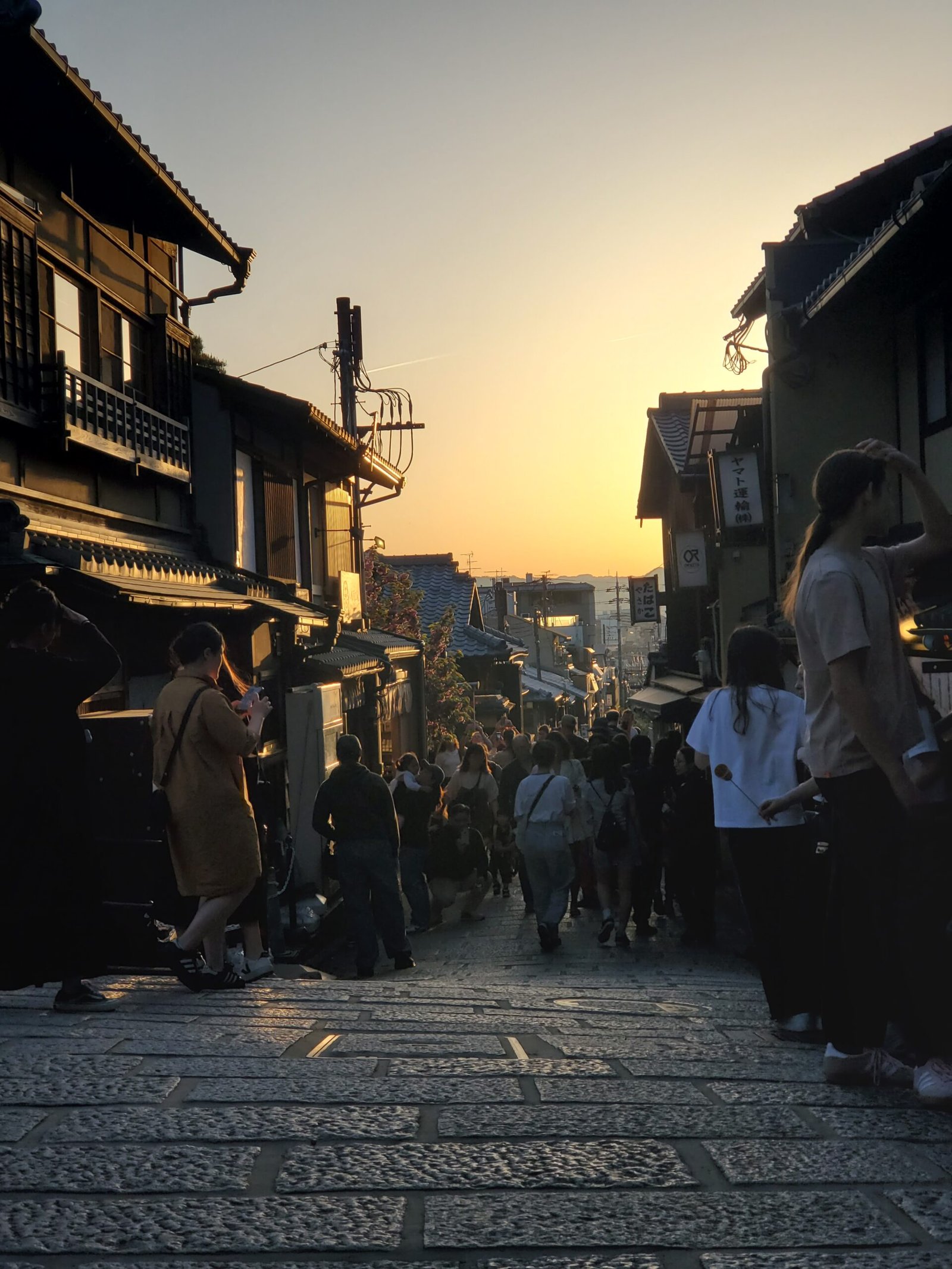
But first, we walked up a bustling street lined with shops and eateries. The incline was noticeable, but the vibrant atmosphere made the hike enjoyable. Along the way, we passed several temples, including Hōkan-ji Temple, commonly known as Yasaka Pagoda. This five-story pagoda is a symbol of Kyoto and stands as a testament to the city’s rich history.
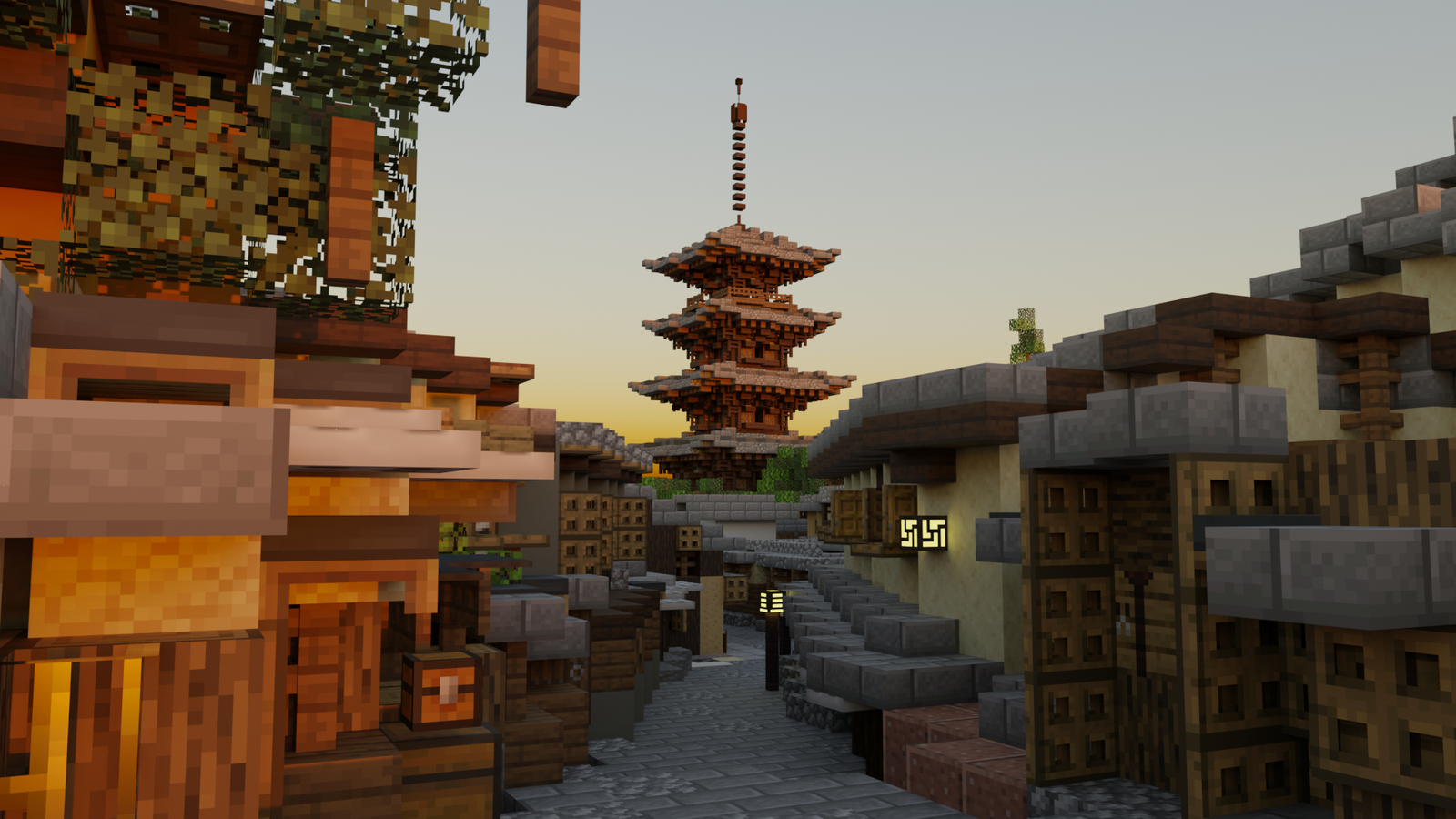
I had previously worked on a Minecraft model of this area through the Build The Earth project, so seeing it in person was a surreal experience.
Reaching the temple complex, we encountered the Nio-mon Gate, the main entrance to Kiyomizu-dera. This impressive two-story gate, reconstructed around 1500 after being destroyed in a civil war, stands as a guardian to the sacred grounds.
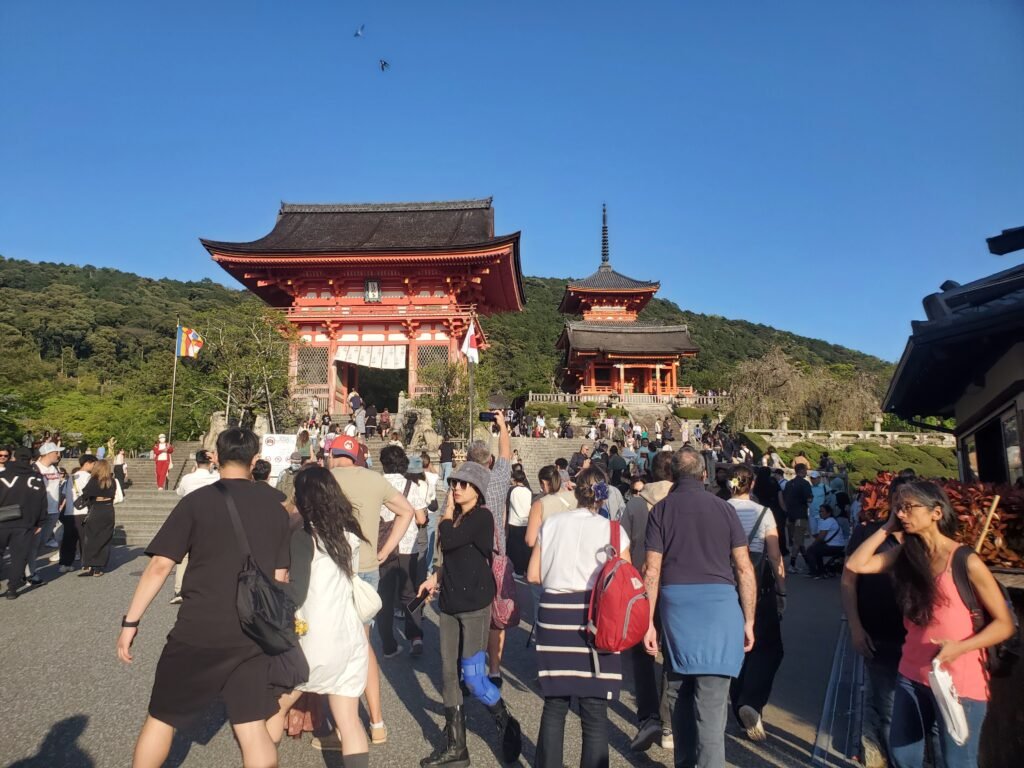
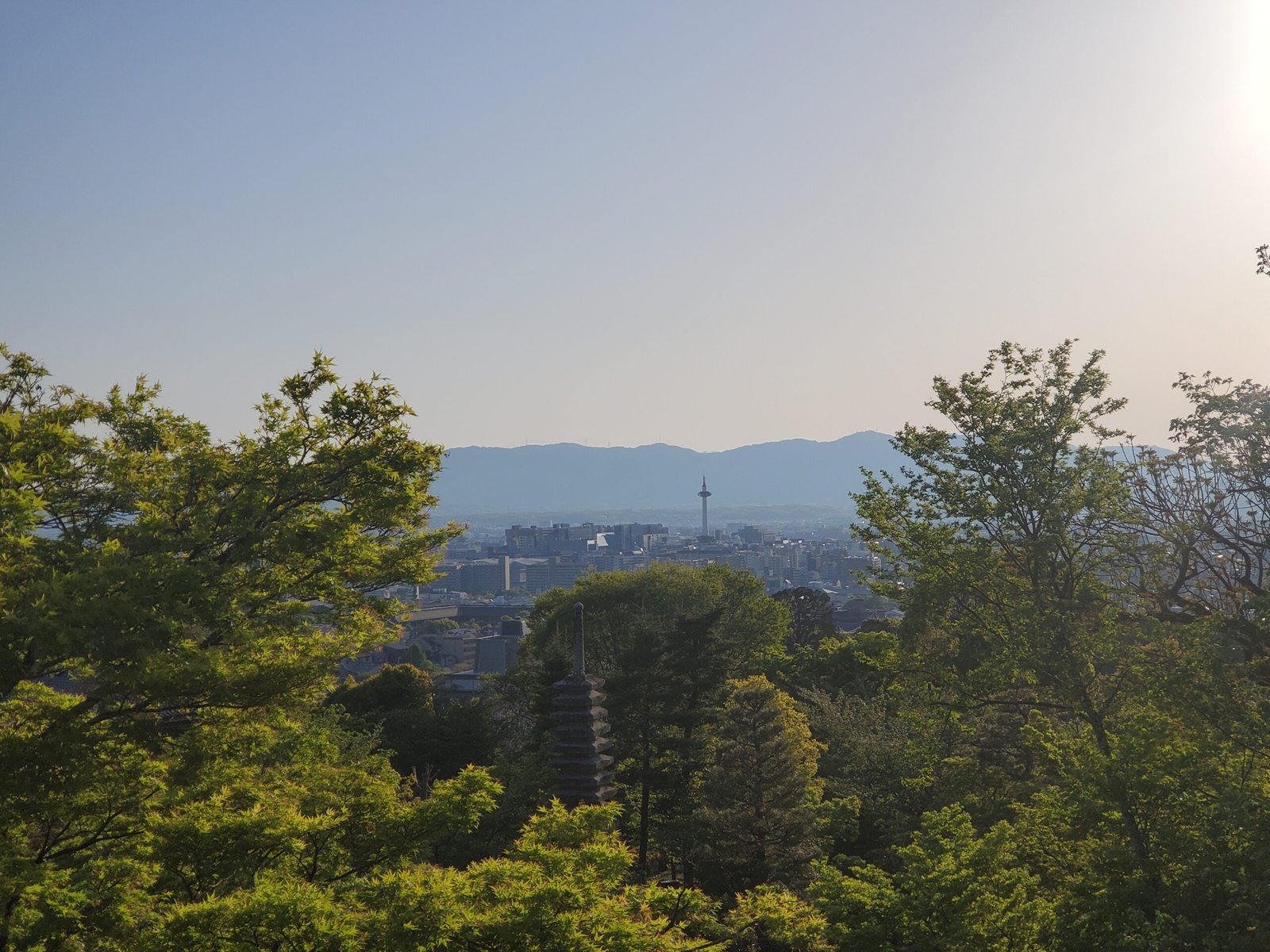
Instead of taking the main stairs under the Nio-mon Gate, we took the wider stairs just to the right, and headed to a vantage point near the Three-Storied Pagoda. From here, we captured stunning photos of Kyoto framed by the temple’s architecture, with Kyoto Tower peeking through the trees.
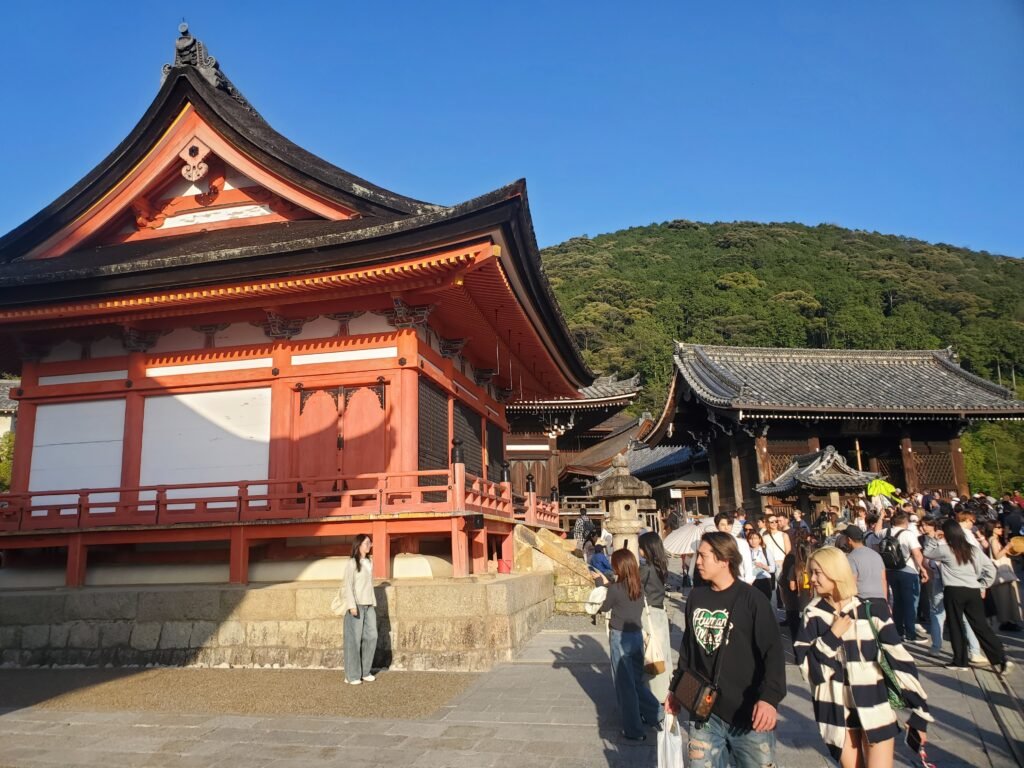
Venturing deeper into the complex, we approached the main hall. The building’s brownish hue and wooden structure suggested it was older than the red-painted buildings surrounding it. However, upon closer inspection, we realized we’d need to pay for admission to enter. There were also way too many tourists, so we decided we could skip that part.
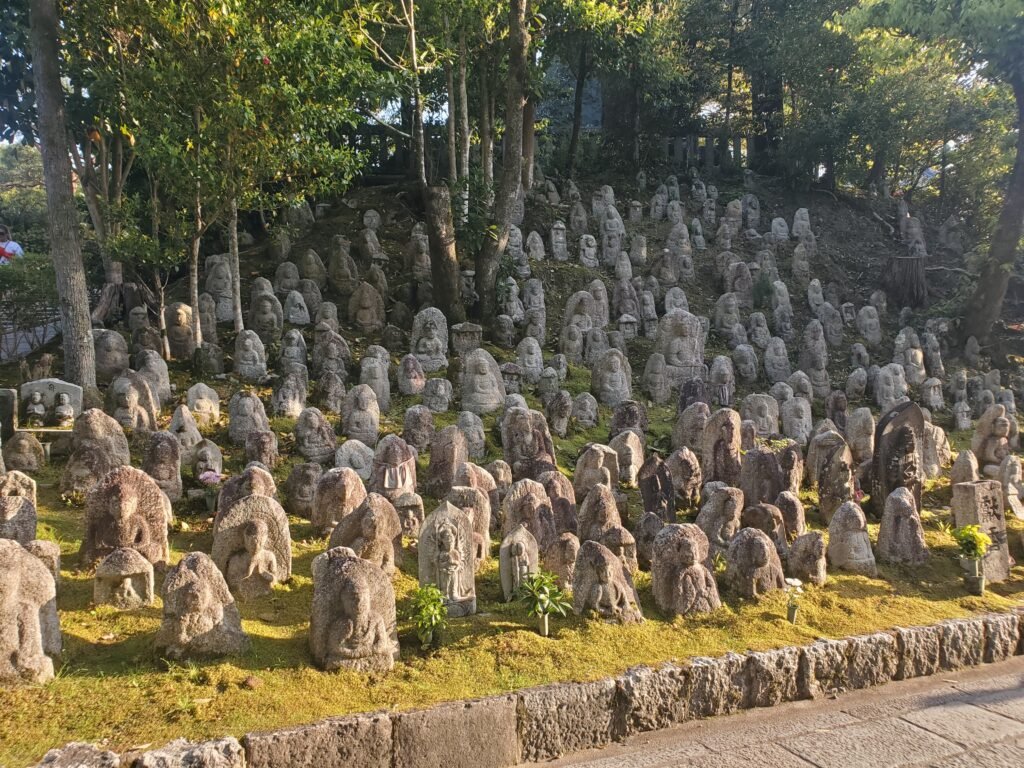
We saw several other areas, but one of the most memorable sights was the Sentai Sekibutsu-gun, or Thousand Stone Buddhas. This serene area features numerous small stone statues, each with unique expressions. It was very interesting to see.
After this, we started headed back down the main street to do a bit of souvenir hunting. Carlos didn’t end up getting anything, but I found a few things. At one shop I picked up a few keychains and trinkets. One in particular was particularly awesome: a tiny sword that unsheathes, with “ancient capital Kyoto” inscribed on the sheath in Japanese. I also spotted a fan shop. I’d been wanting one of these, and I found one with a beautiful ocean-wave design and dolphins on it for only ¥1,000.
We continued walking and almost immediately spotted a small temple that was still open, even though most shrines and temples shut by 4 or 5 pm, so this was a bit surprising to us. This was Hotoku-ji (apparently a sub-temple of Kiyomizu-dera), and to our delight they were still offering goshuin, thanks to a kind lady at the desk.
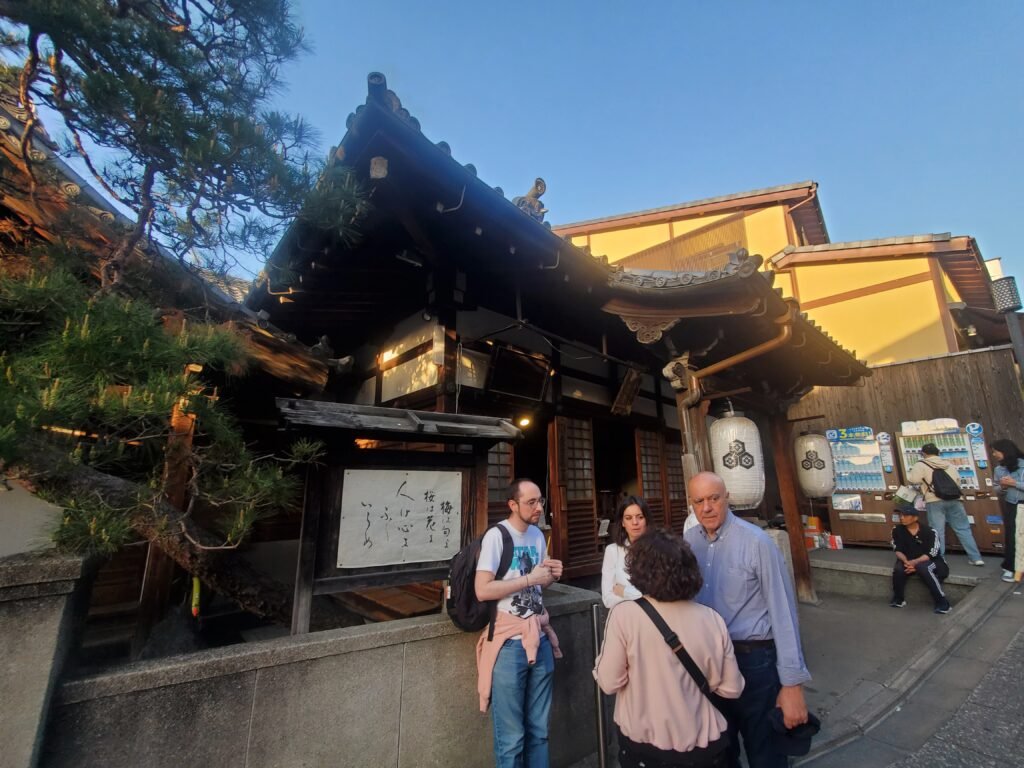
The line was surprisingly short, especially compared to what we’d seen at places like Senso-ji in Tokyo. It made me wonder – how many people even know about goshuin, and if they get a book, do they even collect more than one or two? There are so many unique stamps at different shrines and temples, and they are all made with such precision and care. To me it was one of the most fascinating and heartfelt parts of traveling through Japan, and I’m already excited to collect more on future trips.
Next up, we made our way to Yasaka Pagoda. It is open only a couple days a week, but we knew that in advance – I just wanted to see it more closely. We rested on the stone steps nearby for a bit, though Carlos hurt his foot and needed a few extra minutes to regroup before we headed back towards the hotel. The view from that spot was magical – golden light filtering through the narrow cobbled lanes, people wandering in all directions, and an unmistakable heartbeat of Kyoto as the sun began to set. It gave me a feeling of absolute serenity, and it makes me yearn to go back.
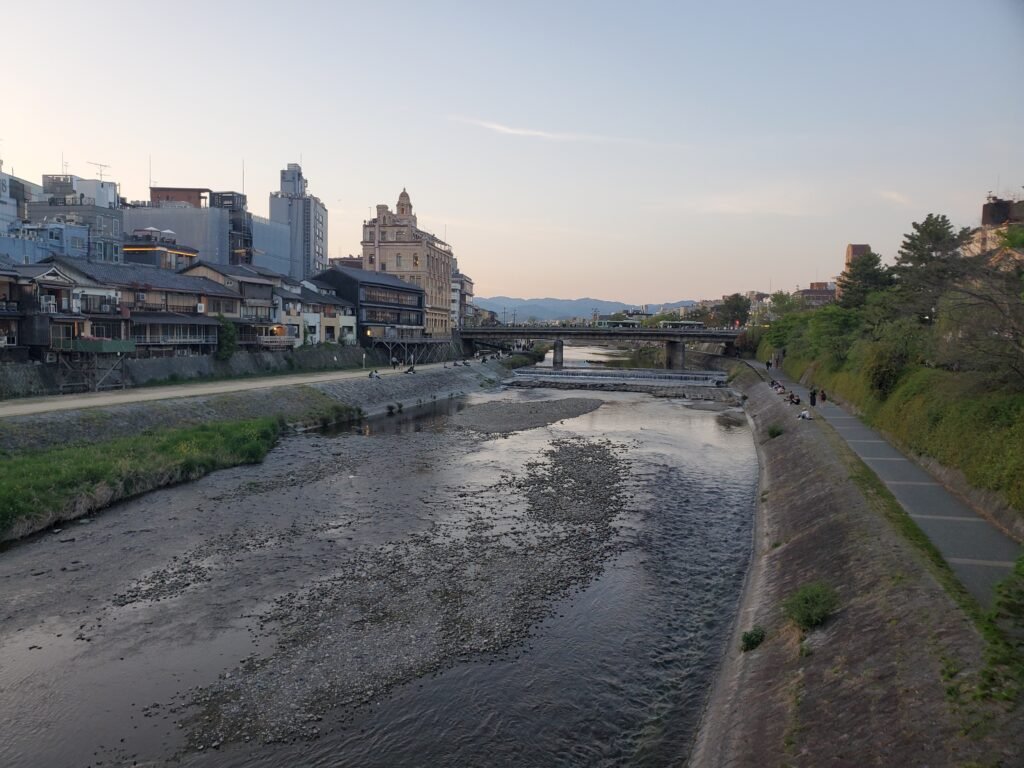
After a bit we kept going. I suggested catching a bus, but Carlos was good with walking – it would have taken the same amount of time regardless. Along the way, we passed under a cluster of torii gates by a shrine, and then walked over a bridge spanning a small river which runs through Kyoto. It was very peaceful and scenic, especially with the dusk lighting.
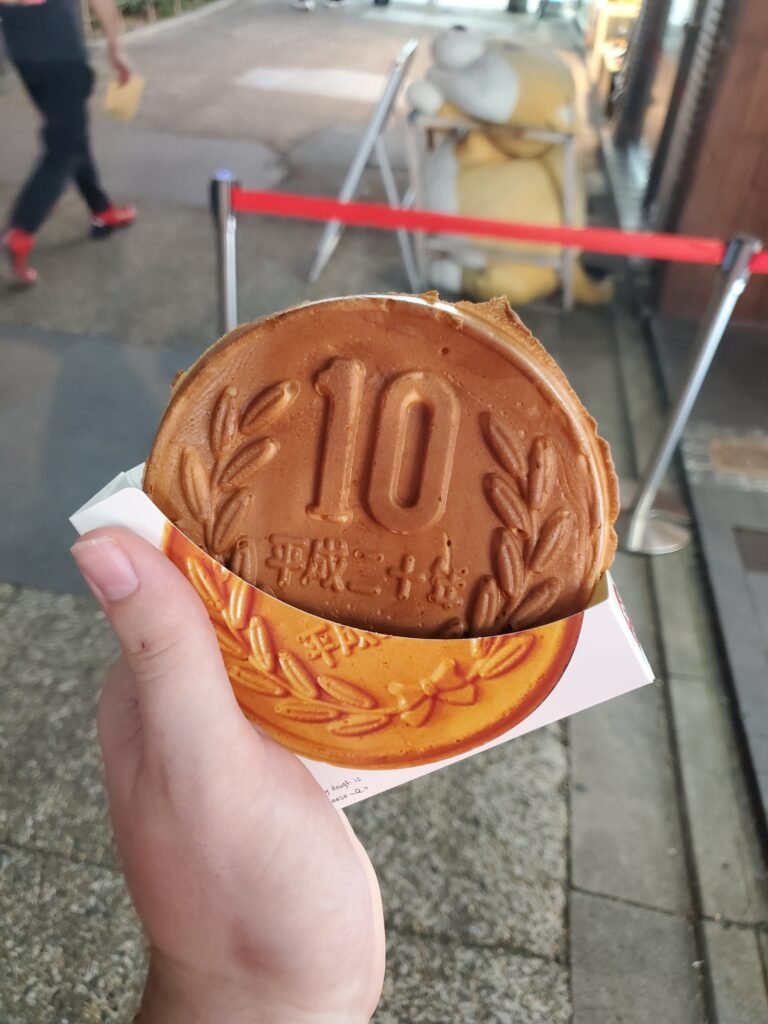
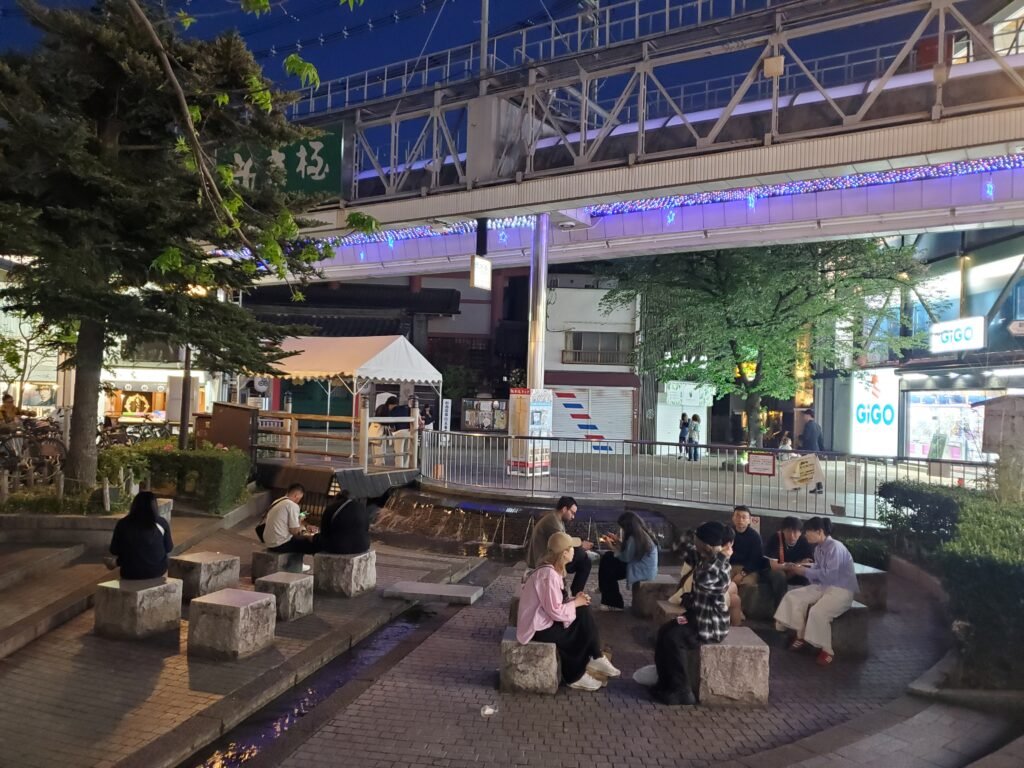
After about 15 more minutes of walking, we made it back to the hotel. I eventually headed out to grab food again, as well as checking out the souvenir shops. While browsing, a particular shop caught my attention: a place selling 10-yen Coin Cheese Filled Bread – it was basically a pancake shaped like a 10-yen coin, filled with gooey cheese. It was awesome. The guy running the stand was solo but super efficient. And it cost only ¥500! I took it to Rokkun Plaza, a pleasant public space near the shopping streets where you can sit and relax.
On the way back, I stopped by a small Chinese shop next to the cheese pancake stand and picked up a fried chicken skewer for Carlos. He was super grateful when I brought it back. After that, we went out again for a bit more souvenir shopping. Finally, content and a little tired, we headed back to the hotel and called it a night – needing to rest up for our full day adventuring around Kyoto. Our first night had been wonderful, but that wasn’t even close to the amazing things we’d see the next day.
[…] From Tokyo to Kyoto: First Impressions […]